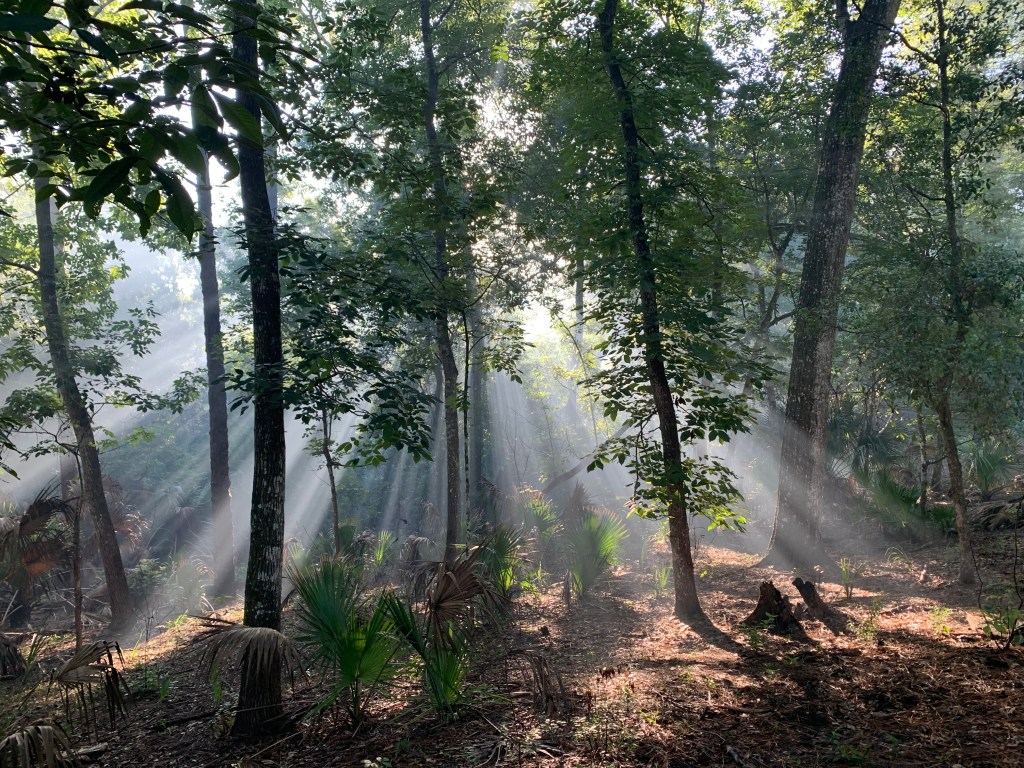
Long before I began backpacking last year, I rekindled a love of hiking on the Volksmarch Loop at Wekiwa Springs State Park. Wekiwa Springs is one of Florida’s most popular state parks, particularly because of the large swimming hole surrounding its spring head and the terraced hill above it full of sunbathing and picnic areas. In fact, it has become so popular that the park has implemented a reservation system from March through the end of August. But if you’re lucky enough to camp there or get one of those reservations, you shouldn’t miss the opportunity to hike.

Spanning almost 8,000 acres, Wekiwa Springs State Park ranges north from its famous spring head, from which 42 million gallons of crystal-clear water flow each day at a constant year-round temperature of 72 degrees. The park also includes Wekiva Springs Run, the stream carrying the waters from the spring head that forms the Wekiva River after it joins Rock Springs Run, another spring-fed stream that runs along the park’s northern border. (For those wondering why the park’s name is spelled “Wekiwa,” the native word “wekiwa” refers to the springhead, whereas “wekiva” refers to the flowing waters, i.e., the river.)
The park also oozes with history. The springs have been drawing visitors ever since they were rediscovered in the 1860s, at which time they were originally named Clay Springs after their owner. In the 1890s, decades before tourists were first drawn to other springs like Weeki Wachee, Wekiva Springs housed a hotel and bathhouse complex that are now long gone. The land now comprising the park was eventually acquired in the early 20th century by the Wilson Cypress Company, which logged its hardwoods and harvested turpentine, before it was eventually sold in 1941 to the Apoka Sportsman Club and used for hunting and fishing. When the region around Orlando began growing, club members who loved these lands campaigned for them to be preserved and sold them to the state of Florida for use as a state park in 1969.

Locals have become well acquainted with the long lines formed outside the park entrance during weekends in the summer by swimmers and sunbathers. But the park is also home to more than 25 miles of hiking trails, which span a surprisingly diverse array of ecosystems from tropical cypress and palm hammocks to mesic flatwoods to sandhill uplands. The area is also positively chockfull of wildlife. Deer can be seen along the trails year-round—my daughter and I used to count deer on our fingers during hikes and often had to use our toes, too. I’ve also seen turkeys, woodpeckers, hawks, gopher tortoises, and even a black bear while hiking.

Although Wekiwa Springs offers plenty of hiking options, from the easy 0.8-mile Wet-to-Dry Trail to the 13.5-mile Main Trail, my favorite has always been the Volksmarch Trail, which forms a loop on the southern side of the park not far from the park entrance. By leaving and returning on a connector trail from the parking lot near the springhead and swimming area, a hike on the Volksmarch covers 5.9 miles and provides access to the wildlife and ecosystem variation that visitors love. The trail also offers a surprising amount of elevation change, particularly on the connector trail where I’ve often seen the most deer.

I’ve always chosen to do the loop counterclockwise, as doing so allows you to tackle the hardest stretch of sugar sand at the beginning (and downhill). After turning right off the connector trail through the oak forest, you eventually emerge into an open pine savannah where the trail turns into a river of sugar sand. Eventually you reach a tropical hammock and hike to a small bridge crossing a stream (this was where I saw my black bear). The trail then climbs into mesic flatwoods full of tall longleaf pine and woodpeckers, before turning left to briefly join the blue-blazed East-West Trail and then the red-blazed Bicycle Trail. Eventually the Volksmarch turns south to join the white-blazed Main Trail, where you return through two miles of sandhills and pine flatwoods to the junction with the connector trail, passing a pretty overlook of Lake Prevatt halfway before eventually meeting the family campgrounds.

Although access to the park can be difficult during the summer months, Wekiwa Springs is a majestic place to hike in the less busy winter and early spring, particularly in early mornings when the trails are cloaked by fog and deer can surprise you around every bend. And even in the summer, there is nothing like taking a cool dip in the springs after a satisfying trek on the Volksmarch.


 RobRogersWriter.com
Leave a comment