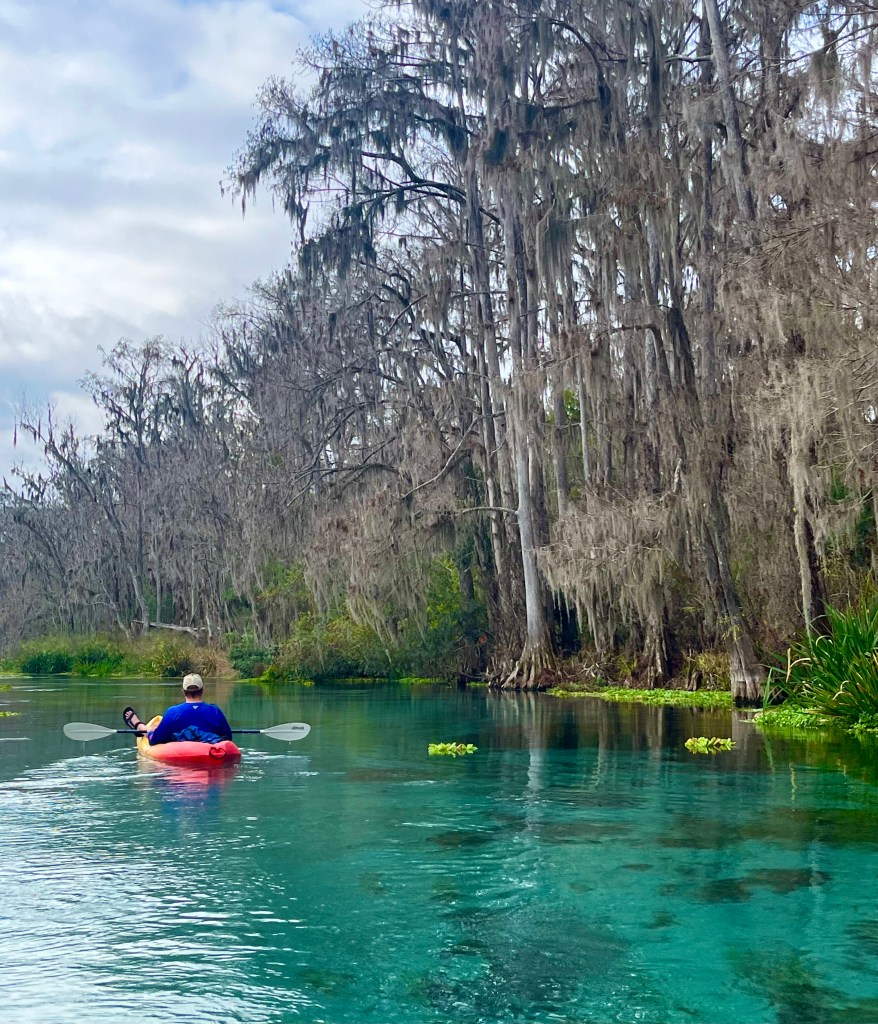
Many University of Florida students are familiar with Ichetucknee Springs State Park and its well-known river that is a summer favorite for river tubing. Way back in my freshman year in the 1990s, the fraternity I pledged even went there in a rented bus and floated a keg down the river. But a far quieter, much more enjoyable time can be had there during the winter off-season. My family and I spent the weekend after Christmas there this year, and it will be far too long before we return again.
Ichetucknee Springs State Park sits just 40 miles northwest of Gainesville and contains the first 3 1/2 miles of its namesake river north of its eventual confluence with the Santa Fe River. Covering 2,669 acres, the park boasts a rich history. Having been the home for centuries to local tribes of Native Americans, the river was also home to a Spanish mission dating back to 1608, the Mission de San Martin de Timucua, which was one of the major interior missions serving the Spanish settlement at St. Augustine. Nearby Fort White and the town of Ichetucknee date back to just after the Civil War and grew largely on the strength of local phosphate mining.

It was eventually the summer tubing escapades of all those college students from UF beginning in the 1950s and ‘60s that persuaded the Loncala Phosphate Company to sell the land now containing the state park to the state of Florida in 1970. After being cleaned and restored from the years of visitors’ litter, the Ichetucknee River and springs were eventually declared a National Natural Landmark in 1972.
The biggest attraction here is the springs. As one of Florida’s 33 first-magnitude springs, the discharge from the underground aquifers pumps hundreds of thousands of gallons of crystal-clear water that draws the tubers and paddlers. The northernmost half of the river within the park is narrow and shallow and only suitable for kayaks, canoes, and paddleboards. The river then widens and becomes more ideal for innertubes beginning at the Midpoint Launch, which remained closed when we visited because of hurricane damage (there are still other places to launch tubes downriver). The Blue Hole near the park’s northern entrance and its deep caves are even popular with scuba divers.

My family and I were blown away by the landscape when we kayaked there shortly after Christmas. The headwaters initially flow over a swaying carpet of aquatic grasses, with the narrow river crowded from shore by overhanging cypress and live oak, some of which tower high overhead. Many portions carve into the limestone karst, with walls as high as ten feet pocked with caves lining the river. Further south the river widens and becomes easy to navigate, often requiring no paddling at all—you just dip your paddle into the river to use as a tiller as the current pushes you along.

A lesser-known feature of Ichetucknee Springs State Park is its trail system. Although the trails near the General Store by the park’s southern entrance mostly run along old tram roads used by the phosphate companies, the northern end of the park contains three different trails that can be connected for more than 3 ½ miles of family hiking, most of which have beautiful overlooks of the river and its springheads. Our favorite was probably the half-mile Blue Hole Trail (one mile out-and-back), which rode along the eastern shore of the river and ended at the gigantic Blue Hole loved by cave divers. The Pine Ridge loop trail that meanders through upland pine forest was also pleasant and easy.

Although Ichetucknee Springs draws massive crowds in the summer, for my money, the time to visit is the winter when you can enjoy the springs in peace and tranquility. By renting our kayaks shortly after the General Store opened around 9 a.m., we were able to have the river largely to ourselves and were spared from the boisterous crowd noise that is surely inescapable in summer months. Herons, egrets, and tons of turtles watched us drift by, and several hawks perched on branches hanging over the river.

Reservations for kayaks, canoes, and paddleboards can be made online or at the park’s General Store near the southern entrance and include transportation to the put-in location at the springhead near the northern entrance. The friendly staff there will take care of putting your watercraft into the water and pulling them out. Current prices are $45 for single-person kayaks, $65 for tandem (two-person) kayaks, $60 for stand-up paddleboards, and $65 for canoes. A wide variety of innertubes can be rented within the park and from private companies outside the park.


 RobRogersWriter.com
Leave a comment