The Dalmatian Coast of Croatia is best known for its archipelago and the rocky hillside towns facing the pristine waters of the Adriatic Sea, and it has become a favorite destination for boaters and enthusiasts of the films and television series like Game of Thrones that have been filmed there. But just inland from the coast lie several national parks with picturesque limestone waterfalls and miles of rivers and trails immersed in lush forests, many brimming with historical sites. If you have an extra day or two while in Split, you should check out Krka National Park, as my family did on the day before we flew home from our recent one-week sailing charter through the islands near Split.
Less famous than its more inland cousin at Plitvice Lakes, Krka National Park lies just an hour north of the coastal town of Split and can be easily reached by car or on bus tours departing daily from Split. Formed in 1985, Krka National Park spans almost 27,000 acres through the canyons and valleys containing 31 miles of its namesake river. Its historical sites span thousands of years of local history, from caves inhabited since prehistoric times to the ruins of a Roman amphitheater and military camp, to medieval hilltop fortresses and island monasteries, to some of the world’s first hydroelectric plants. It also contains more than 13 miles of walking trails and 29 miles of biking trails.

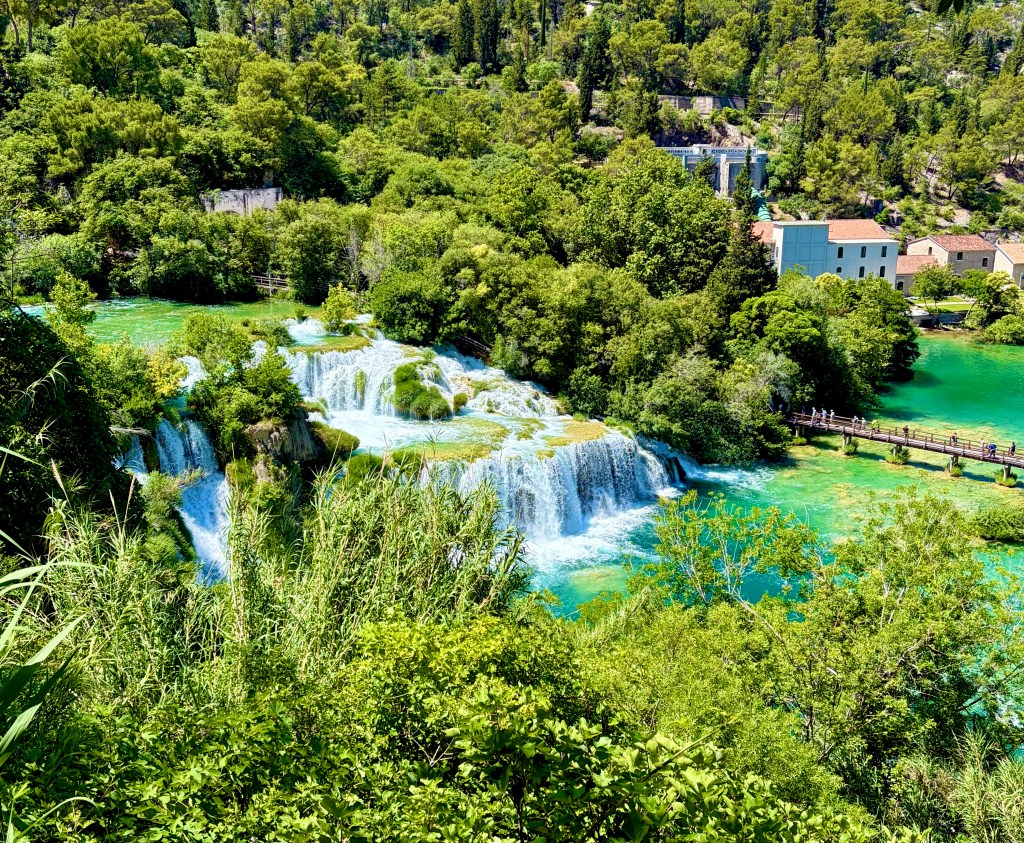
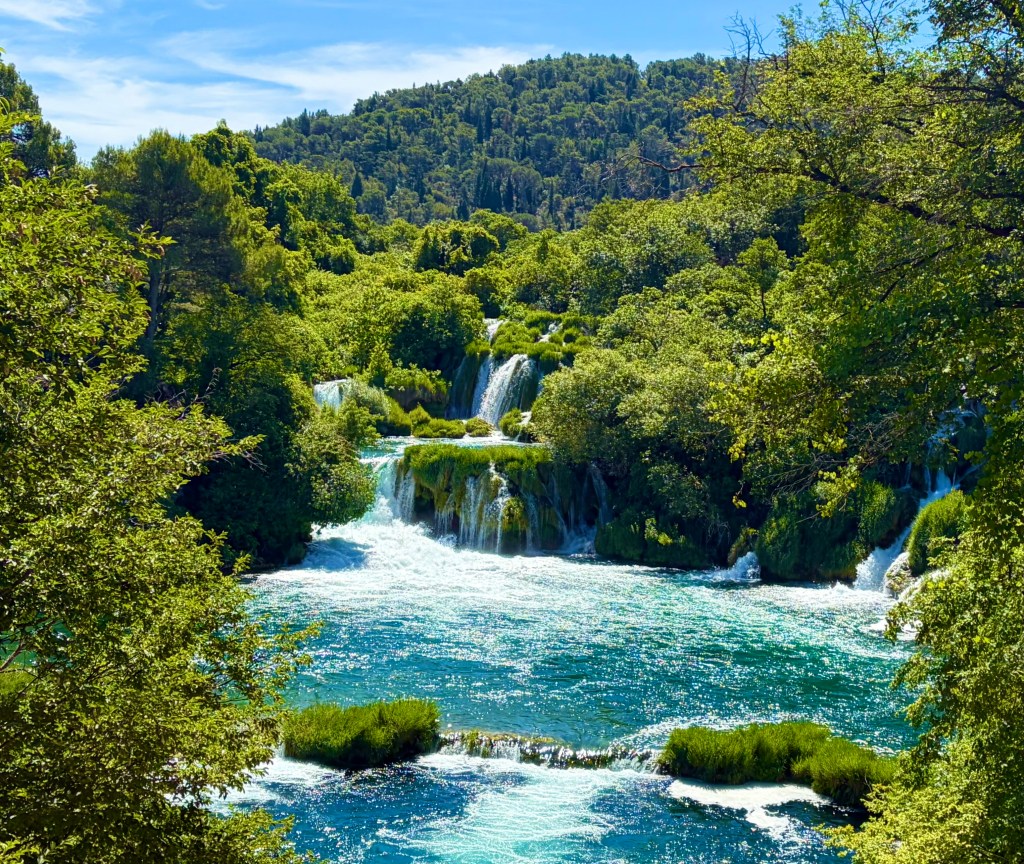
But the real attractions at Krka are the waterfalls. Formed from tufa, a form of limestone that grows and expands from the accumulation of mosses and algae that become a permanent part of the rock when they die, Krka’s waterfalls are constantly changing, with riverside stalactite features reshaping the cascading falls each season. The falls are also covered in the summer with lush greenery and surrounded by deciduous forests, which attracts thousands of plant and animal species, including migrating birds and pretty blue dragonflies that seemed straight from central casting for an Alice in Wonderland film.

Having only several hours to tour Krka, our family spent our morning there at Skradinski buk falls. Our tour guide prudently had us take the 1.5-mile system of boardwalks and trails in reverse (clockwise) to avoid being caught behind large tour groups. We began our short descent along the southern side of the falls past the Imperial Lookout, built for Austrian Emperor Franz Joseph I during his visit there in 1875. The walk downriver then takes you through the park’s Ethno Village with several restored buildings, including an old riverside mill, a stone house, and an outdoor kitchen and iron smith building, all of which allow you to picture what life was like for the region’s past residents.

Shortly before reaching the base of the falls and its sea-level meeting point with brackish portions of the Krka River, you reach the ruins of the original Krka Hydropower Plant. Technically the world’s second hydroelectric plant, it began operations just two days after Nikola Tesla’s plant opened at Niagara Falls in 1895, but the one in Krka was the first in the world to supply electricity to a city (the nearby historic city of Šibenik). One of the plant’s original turbines sits just uphill from the original plant.

You finally reach the base of the falls and cross the river on a boardwalk that provides perfect views of some of the falls’ most scenic cascades. After passing a boat tour hub on the north side of the river with souvenir shops and outdoor restaurants, you ascend back through the more forested northern bank of Skradinski buk, passing pretty tiny falls trickling through cracks in the limestone and along the shore of upriver ponds filled with fish swimming against the current in crystal clear water. Although the lowest portion of the trail here climbs some steep steps, most of the top portion crosses flat, shaded boardwalks.

Krka National Park can be very busy in the summer, when parking can fill early and park passes can be tricky to find online. For a more informative and intimate experience, you might prefer a guided tour like the one my family chose, and you can’t go wrong with Dream Tours Dalmatia. We spent a wonderful day with Petar Sinovčić, owner of Dream Tours Dalmatia, who showered us with historical and ecological insights during our daylong tour of Krka National Park, Šibenik, and the tiny seaside town of Primošten. Our tour also included a sumptuous lunch at a pretty restaurant and drives to spectacular hilltop overlooks of the towns we visited and the Croatian Archipelago.
If you plan to visit Croatia and are looking for a great inland location near Split to enjoy the outdoors, Krka National Park should not be missed.


Leave a comment