
As I mentioned in a recent post about Krka National Park, my family and I returned earlier this month from an exhilarating trip touring the Dalmatian Archipelago in Croatia on a chartered 46-foot sailboat. This came just as I began to appreciate how tricky it had become to write new posts about hiking here in Central Florida since the summer heat has driven me into a seasonal hiatus from backpacking.
Even though we didn’t hike or backpack during our trip, I can’t pass on the opportunity to celebrate the enchanting islands and towns we visited during our recent adventure in Croatia. So for the next several weeks, I’ll share my version of a travel log in a series of blog posts about the places we visited.

This week, I’ll begin with Vis.

The island of Vis, where we arrived on the second day of our trip, was the most distant stop we visited from our home port of Split, although it is still less than a half-day’s sail from Split. Vis is perhaps best known for its scenic coves and beaches and is therefore a popular spot for tourists on swimming day-trips from Split and the nearby island of Hvar.
Covering less than 35 square miles and with a population of fewer than 4,000 residents, Vis is one of the Dalmatian Archipelago’s least developed and most picturesque islands. It also has a rich history, having been founded in the 4th century B.C. by Greeks as the colony of Issa, then later being absorbed over time into the Roman, Venetian, and Austrian Empires before eventually becoming part of the modern Republic of Croatia.

After being incorporated into the ill-fated Kingdom of Yugoslavia in 1920, Vis served as a naval base during World War II and as the general headquarters of the Yugoslavian resistance to Hitler and Mussolini led by Josip Broz Tito, who went on to lead Yugoslavia until his death in 1980. Yugoslavia eventually abandoned its naval base and opened Vis to the public in 1989, shortly before the violent civil war in the 1990s that led to the nation’s disintegration back into its now-independent states. Vis then became one of the early islands to help stabilize Croatia’s post-war economy through tourism that supplemented the island’s traditional income from wine production.

On our visit, we tied up our sailboat along the riva (waterfront) at the island’s namesake town of Vis, home to approximately half the island’s population. As the producers of a recent Mamma Mia sequel recognized when they chose the island as the backdrop for its fictional Greek setting, Vis possesses all of the charm and ambiance of a quaint Mediterranean seaside village.

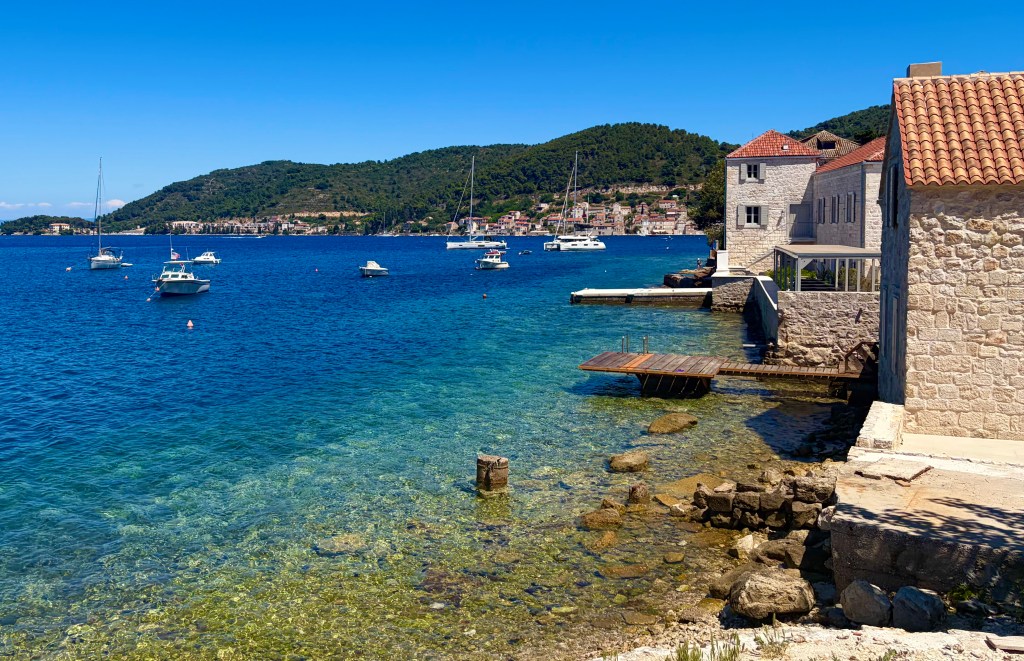
Nestled against vineyard-covered hills, the cobblestoned lanes of Vis cluster around its bay, with limestone homes and churches abutting the waterline with small piers crossing crystal clear waters to small fishing boats. Most of the town’s cafés and shops were still closed when we arrived on a sunny Sunday afternoon, but they eventually opened to host the tourists who arrived on their sailboats to enjoy sunset walks along the riva and dinners of locally caught delicacies.
Just uphill from town sits the Lipanović Winery that we toured before dinner, a family-run wine grower whose operations are housed in tunnels cut into the hills by the Yugoslavian military. Then across the bay from where we docked lies the pebbly Prirovo Beach where we swam the next morning, on the north side of a small peninsula shared by a 16th century monastery.

The main attraction of Vis is its quiet ambiance. It teases you to meander up and down its old, cobbled alleys beneath windowsills holding colorful flowers, forgetting about the passage of time that seems to sit still there anyway. Far from crowded coastal towns and their lines of frazzled cruise ship tourists, Vis is the perfect place to disconnect and relish the sun and the Adriatic Sea.
Although Vis can be reached easily by a two-hour ferry from Split, there’s no better way to enjoy it than on a sailboat tied stern-first to the waterfront. It’s definitely worth a stop if you plan to visit Croatia.


Leave a comment