During my summer hiatus from backpacking in Central Florida, I’ve decided to spend the next several weeks posting about the towns and islands my family and I visited during our weeklong sailing trip in June on the Dalmatian Coast of Croatia. If you’re interested in learning more about what it’s like to charter a sailboat in the Adriatic (including costs of renting a sailboat and hiring a skipper), check out my latest article in Go World Travel, “Why a Croatian Sailing Charter is the Perfect Family Vacation.”

This week, I’ll discuss Split and Trogir.

We began and ended our sailing adventure in Split, one of Croatia’s best-known destinations for cruise ships also bound for Dubrovnik, Venice, and the Greek Isles. Although it was not a part of our sailing itinerary and is not exactly a refuge from crowds, its well-known Roman palace and medieval charm make it a favorite for tourists. Its sister port of Trogir just down the coast also offers an enticing, cozier contrast. Even if you prefer the tranquility of small villages like those described in my recent posts, you should not miss the chance to see Split and Trogir.
Split

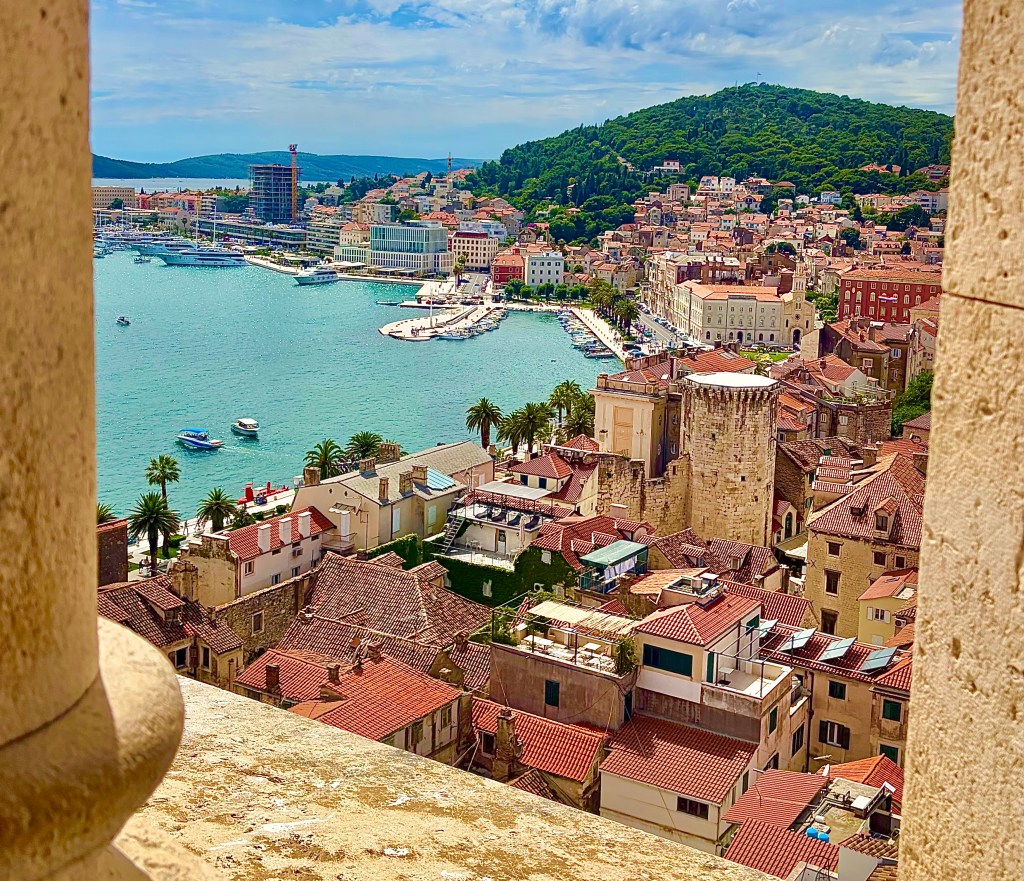
From its perch beside a bay beside the Marjan Peninsula, Split is the beating heart of the Dalmatian Coast. It hardly feels like Croatia’s second largest city to visitors who don’t venture far beyond its Old Town by the harbor, as most of its 160,000 residents live further inland. But by the Riva (the Italian term for harbor descended from the Venetian influence there), Split percolates with pleasure-seeking tourists drawn to its ancient relics, restaurants, and seaside vistas.

Originally founded by the Greeks in the 3rd century BC, Split rose to prominence after the Roman emperor Diocletian, born in nearby Salona, chose to build his seaside 320,000-square-foot palace to retire there at the end of the 3rd century AD. Following the fall of the Roman Empire, Split’s descendants fled within the palace walls to escape foreign invaders and built their own town among its ruins, before the town eventually grew outward into the city it is today.

Much of Diocletian’s Palace remains standing, and as a UNESCO World Heritage Site, it attracts hundreds of thousands of tourists each year. Our favorite Roman ruins were the enormous vaulted cellars near the Palace’s seaside southern wall, and the central Peristal (square), vestibule, and Cathedral of St. Domnius near the interior entrance to the emperor’s living quarters were also impressive. My wife and daughter also enjoyed the views from atop the cathedral’s bell tower. (My fear of heights and I stayed below on solid ground.)

Split is also famous for its seaside Riva, which runs from the southeastern corner of Diocletian’s Palace to the shop-lined Marmontova, a pedestrian street leading inland. The Riva attracts flocks of people-watchers throughout the sunny summer months, as do the pretty squares surrounding the Palace that host fruit markets and summer festivals. Split is also home to one of Croatia’s largest universities and supports a thriving nightlife scene. For those less interested in bars or history lessons, Split also has trendy restaurants appealing to those seeking fine dining.

My family and I most enjoyed wandering among the cobblestone alleys within the northern half of Diocletian’s Palace and in the neighborhoods near the apartment we rented just uphill from the Old Town. Even during busy afternoon hours, we were surprised at how easy it was to find quiet corners to enjoy centuries-old facades while cooling ourselves with gelato. Although Split could hardly be described as quiet in the way Vis and Stari Grad were, it was well worth the two nights we spent there before we set sail.
Trogir

Across Kaštela Bay about 17 miles west of Split lies the much smaller but equally picturesque town of Trogir. With roots dating back to the ancient Greeks, the tiny island containing Trogir’s old town retains the street plan dating back to before the Roman Empire and, thanks to prosperity achieved beginning in the 13th century, is now home to the best-preserved Romanesque-Gothic complex in Central Europe. It, too, is a UNESCO World Heritage Site.
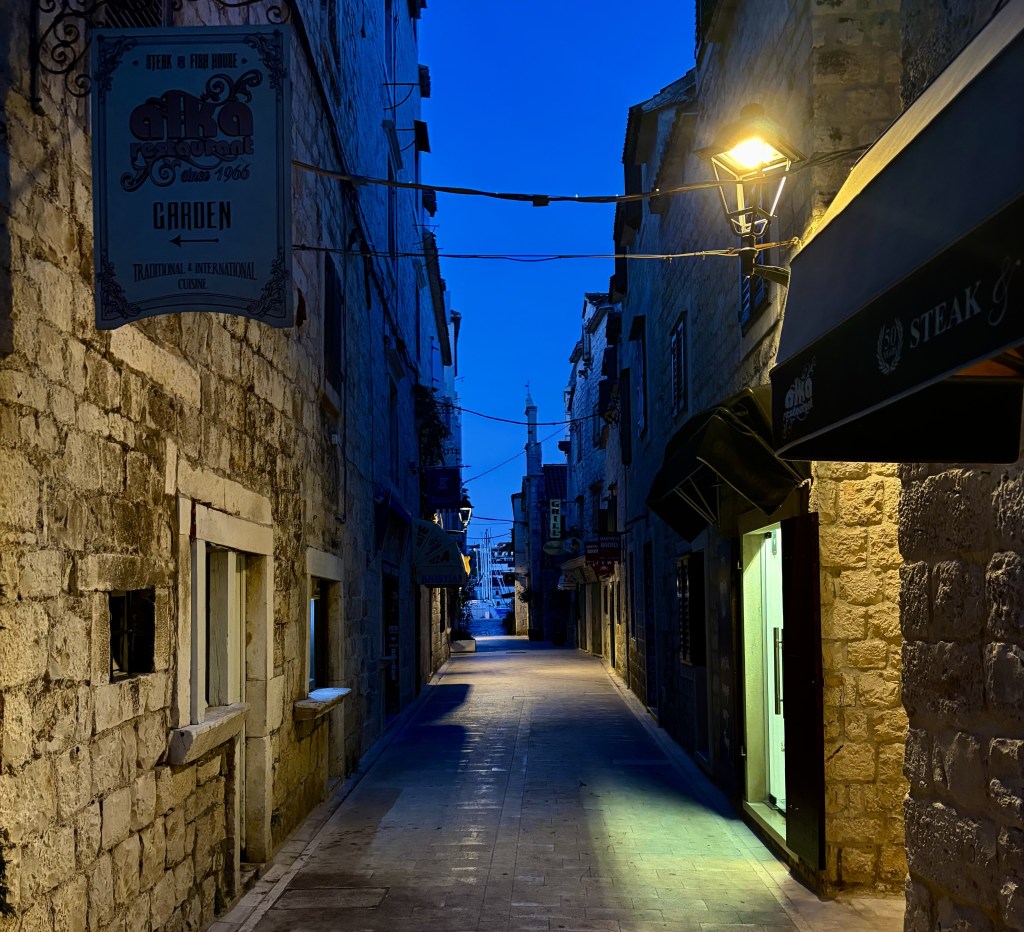
Trogir is best described as cozy. Having arrived at 5:30 p.m. the Saturday before we flew home after an exhausting daylong guided tour of Krka National Park and Šibenik, we were able to explore the entire island before having dinner at 8:30, often getting lost and then finding our way again among the narrow alleys. The small three-story home we rented was nestled in a tiny square just one block from one of the main pedestrian lanes, yet we couldn’t hear any of the tourists walking nearby even before the dinner crowds dwindled.

Besides the quaint charm of its cobblestones and cafes, Trogir is best known for its Romanesque and Gothic palaces and cathedrals and the 15th century Kamerlengo Fortress on its western tip. We particularly enjoyed the finely sculpted portal (entranceway) of the Cathedral of St. Lawrence, a masterpiece from the 13th century carved by the Croatian master Radovan. Trogir also has its own pretty Riva lined with sailboats and yachts.

Trogir is an ideal place to spend the night before an early flight home, as it sits only four miles from Split’s international airport and is much closer than Split itself. Trogir is also a favorite for sailors arriving in pleasure craft, as its marina is located just across from the Old Town on the nearby island of Čiovo. (Though also nestled in beautiful surroundings, our marina in Split was more than a mile over hilly terrain from where we stayed. Although the walk to Split’s attractions from the marina may be reasonable without luggage, we chose to Uber there.)
If you plan to use Split as the base for a sailing charter, you should definitely plan to spend an extra day or two in Split and Trogir.


Leave a comment